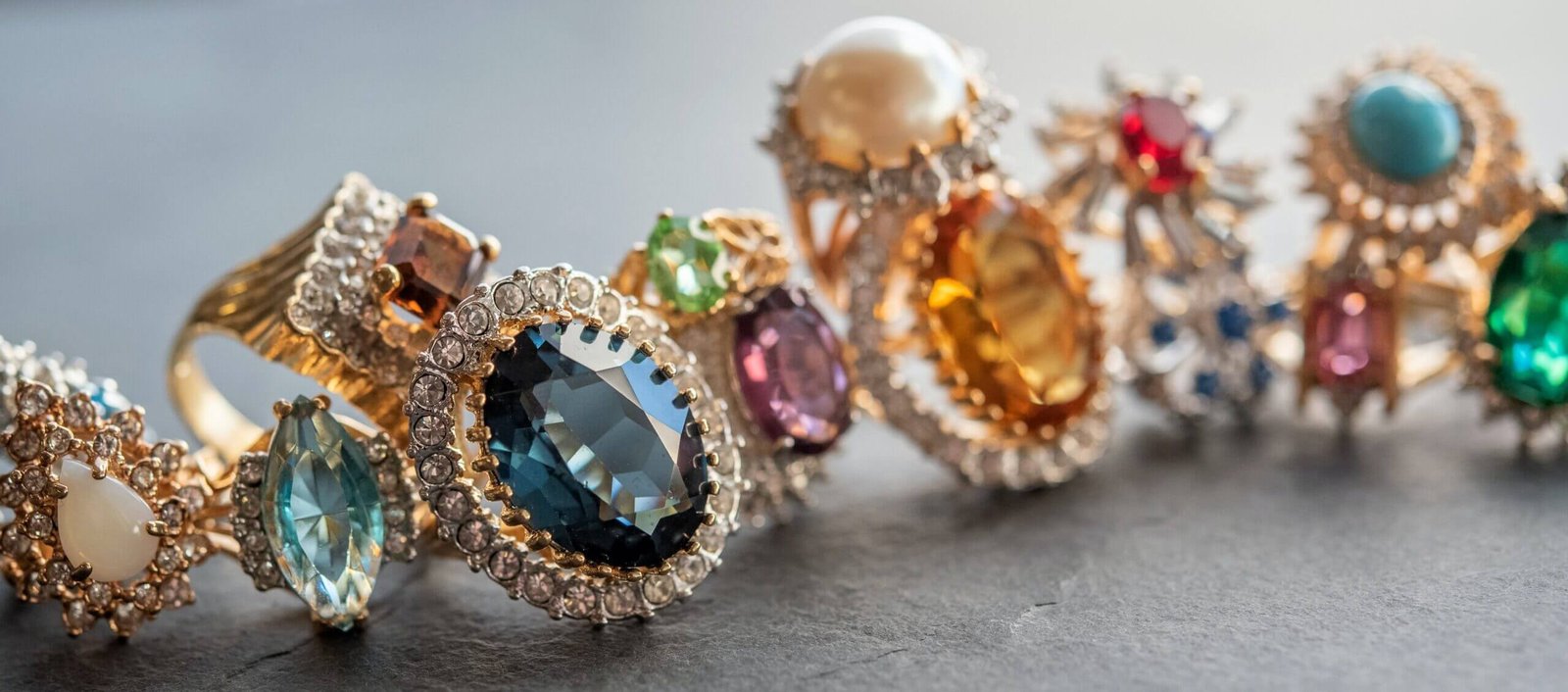
Have you ever stood in front of a tray of polished stones and found yourself asking, “Which of these colours are real and which have been dressed up to look more interesting?”

What Colour Is Agate Naturally?
You’re about to learn that agate, by its very nature, prefers subtlety over spectacle. At its core, agate is a banded form of chalcedony — microcrystalline quartz — and it usually forms with a palette that starts near white or gray. From there, trace impurities, iron, manganese, copper, and other minerals introduce a range of natural hues. But you’ll also discover that people like to tinker with those hues, dyeing and treating agates until they look like a sunrise caught in glass.
The simplest answer, and why it’s incomplete
If someone offers a one-line answer — “Agate is gray or white” — they aren’t wrong, but they’re being lazy. Natural agate commonly appears as white, gray, or translucent, but you’ll regularly find natural agates with brown, red, yellow, green, blue, and black tones. The variation is due to the chemistry of the fluids that formed the agate and the microscopic impurities trapped inside.
How agate forms — and why formation affects colour
You’re not only learning rock names; you’re reading a short biography of a stone. Agate forms when silica-rich waters fill cavities in volcanic or certain metamorphic rocks. As silica gelatinously deposits layer upon layer, it traps impurities and creates the banding that makes agate so beloved. Each band is a short geological sentence; the colour of that sentence depends on what was falling out of solution at that moment.
Banding: the architectural blueprint of colour
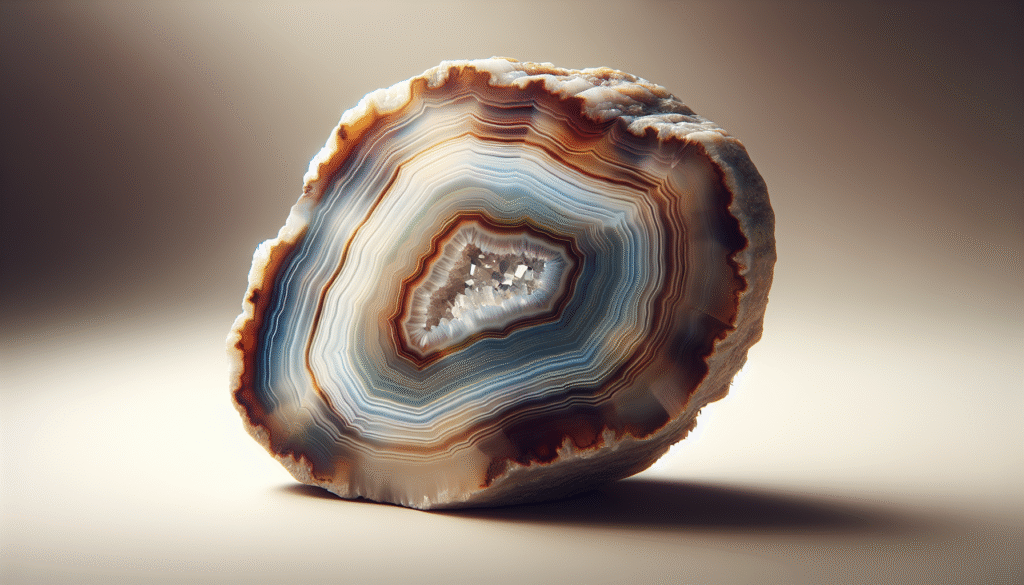
Banded layers are agate’s signature. The bands may be subtle — nearly translucent — or bold, with distinct colour changes. You should think of banding as a timeline: changes in chemistry, temperature, and the supply of mineral impurities cause colour shifts. If a layer sits between iron-rich and iron-poor fluids, you’ll see warm tones adjacent to cool ones.
The role of trace elements
You want specifics? Here they are: iron produces yellow, orange, and red; manganese can produce pink to purple tones; copper introduces green or blue; carbon and organic material can darken areas to brown or black. The exact shade and intensity depend on concentration, valence state, and the way atoms are incorporated into the silica structure.
Common natural colours of agate and what causes them
You’ll appreciate a tidy list. Below is a table that clarifies typical colours and the most likely reason behind each. Remember: geology rarely offers perfect one-to-one correspondences, but this table gets you close.
| Colour | Typical cause / impurity | Notes |
|---|---|---|
| White / translucent | Pure silica, very low impurities | Common in many agates; often the background or banding material |
| Gray | Fine inclusions, microcavities, or low impurity content | Often neutral shading between other bands |
| Black | Organic carbon, iron oxides, or very dense inclusions | Can be natural or enhanced; check for dye |
| Brown / tan | Iron oxides (limonite, goethite) | Common in fortification agates and banded specimens |
| Red / orange | Hematite (iron oxide) | Typical in lake agates and Brazilian agates |
| Yellow | Goethite, iron hydroxides | Often subtle, close to brown tones |
| Green | Copper-bearing minerals, chlorite | Green agates can also be weathered or stained by surface minerals |
| Blue | Copper or very fine inclusions, sometimes light scattering | Natural blue is rarer; many blue agates are dyed |
| Pink / purple | Manganese, colloidal inclusions | Often subtle; vivid pinks/purples may be dyed |
| Multi-coloured (banded) | Alternating impurity conditions | The classic agate look: concentric bands of different hues |
Which colours are truly rare?
If you’re hunting rarities, natural vivid blues and intense purples are unusual. Blues often result from scattering effects (tiny cavities) rather than a stable chromophore, making them less saturated. If you find a screamingly electric blue agate at a market, approach with caution — it’s commonly dyed.
Types of agate named for colour and pattern
You’ll enjoy these labels because they tell a story. Some agates are named after locations, others for patterns. The colour-based names often reflect the natural appearance — but sometimes they’re merely marketing.
Moss and dendritic agate
Moss agate features green, moss-like inclusions produced by manganese or iron oxides. Despite its plant-like appearance, nothing organic is trapped there. Dendritic agate has tree- or fern-like branches (dendrites) caused by manganese or iron oxides. Both are typically earthy green, brown, or black on a white to translucent base.
Fortification agate
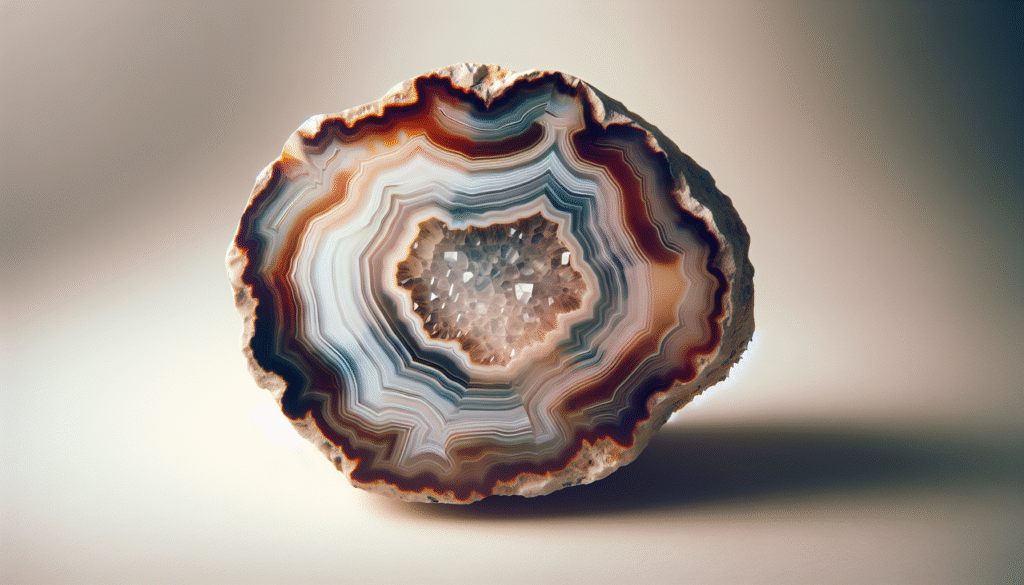
Recognizable by its concentric, roadway-like bands, fortification agate often shows strong browns, reds, and grays. The bands can look like a map or the rings of a fortress — hence the name. These colours are generally natural and related to iron content.
Botswana agate
From Botswana, Africa, these agates frequently show pastel pinks, grays, white, and subtle browns in fine banding. The palette is restrained and elegant, and if you find intense, neon hues labeled “Botswana,” you should be skeptical.
Blue lace agate
Blue lace agate is a soft, sky-blue stone with fine, lacy banding. There are genuine natural specimens, largely from Namibia, but the market also contains dyed and heat-treated pieces. The natural ones are pale and delicately banded; electric blues are rarely authentic.
Fire agate
Notable for iridescent, flame-like patches, fire agate gets that color play from thin-film interference in layered silica and iron oxide. Colors range from reddish-brown to bright oranges, greens, and sometimes blue flashes. These are natural, but the most spectacular specimens are still relatively uncommon.

How to tell if the colour is natural or enhanced
You’re buying something pretty and possibly expensive, so you should be able to test it. Many agates on the market are dyed to exaggerate colours, stabilize patterns, or simply make them more saleable. There are several tests and clues you can use to assess authenticity.
Visual clues
Look for colour concentration along fractures, drill holes, or the outer rind. If the colour pools in cracks or is unnaturally uniform across a slice, it’s probably dyed. Natural colours usually follow banding and vary in intensity with translucency.
Solvent and chemical tests
A quick test you can try at home: apply a drop of acetone or nail polish remover to an inconspicuous area. Dye will sometimes bleed or smudge. Bleach can also reveal unstable dyes, but it’s harsh and can damage some materials. Use caution and test unimportant areas — and be aware that some dyes are stable and won’t react.
Hot water test
Heat can bring dyes to the surface. Soak a small area in very hot (not boiling) water — if the water discolours, a dye has likely leached out. Again, avoid this test on finished jewelry where heat might loosen glue or damage settings.
UV light
Under ultraviolet light, certain dyes fluoresce. Natural chalcedony rarely fluoresces strongly, so a bright neon glow is a red flag. However, absence of fluorescence doesn’t guarantee a stone is natural.
Magnification
Use a loupe or microscope. Natural colour tends to follow banding and appears integrated with the silica. Dye often sits in surface pores or along cracks and may show a sharp boundary under magnification.
Advanced lab tests
If you’re spending thousands, you’ll want lab certification. Spectroscopy, trace element analysis, or microscopic study can prove natural coloration and document treatments. Reputable labs issue reports that can make resale easier.
Treatments commonly used on agate
You should assume the possibility of treatment. Aggressive dyeing, heat treatment, smoke treatment, and clarity enhancement are common.
Dyeing
Dyeing is the most widespread. Sellers often use aniline dyes to saturate porous slices. Some dyes are subtle and intended to enhance contrast. You can usually spot dye by the unnatural brightness, pooling, or colour on the back of thin slices.
Heat treatment
Heating can intensify or change colours by altering iron valence states. Heat treatment is legitimate and stable when disclosed; undisclosed heat treatment is a problem only if it misrepresents value.
Smoke treatment (Brazilian smoke agate)
A traditional technique where agate slices are exposed to organic smoke that permeates the silica and produces rich brown to black tones. It’s an accepted enhancement when disclosed, and in some localities it’s considered a traditional look.
Stabilization and impregnation
Some agates with open porosity are impregnated with resins or polymers to improve polishability and durability. The treatment increases durability and is common in some chatoyant or porous specimens.
Identification quick reference table
Use this table to quickly assess whether an agate’s colour might be natural or treated.
| Observation | Likely interpretation |
|---|---|
| Colour follows banding, subtle variations | Often natural |
| Intense neon colours (electric blue, vivid pink) | Very likely dyed |
| Colour concentrated in cracks or drill holes | Dyed or surface-treated |
| Surface tackiness, polymer smell when warmed | Impregnated/resin-treated |
| Uniform vivid colour across entire slice | Likely dyed |
| Fluorescent bright glow under UV | Possible dye presence |
| Colour changes slightly with heat | May be heat-treated; could be unstable dye |
Sources of naturally colourful agates
You’ll enjoy knowing where notable agates come from. Different geological settings produce signature styles.
Brazil and Uruguay
These countries are major exporters. Brazilian agates are abundant and vary widely — fortification agates, banded slices, and those used for bookends and large displays. Uruguay and southern Brazil yield marvelous banded agates with natural reds, browns, and grays.
Botswana
Botswana agates are famous for fine banding and pastel hues — subtle pinks, whites, and grays. Genuine Botswana agate has delicate, exceptionally fine bands that you can recognize once you learn to look.
India
India produces a lot of agate, including material that is later dyed. The Deccan Traps region yields many attractive agates, often sold in dyed, polished, and bead forms.
Madagascar
Madagascar supplies colorful and banded agates. You’ll find a range of pastel and vivid specimens, but, like other sources, some material is dyed before export.
Mexico (Chihuahua)
Fire agate largely comes from Mexico; these specimens are prized for their iridescence and deep, warm tones created naturally by iron oxide films.
United States
The U.S. produces agates too — Lake Superior agates, Montana agates, and others. Lake agates have vivid red and yellow iron staining because of iron-rich parent rocks.
How colour affects value
You’ll want to know how colour changes price. Natural, rare, well-formed colours and patterns increase value. But value is also about symmetry, banding, translucency, and polish.
Natural rarity
Colors that are naturally intense and rare (subtle but striking blues, remarkable fire) command higher prices. Conversely, dyed stones, even if beautiful, often command lower prices because the treatment is common and reversible.
Pattern and banding
Exceptional fortification lines, eyes, or lace patterns often matter more to collectors than a single saturated hue. A soft, perfectly banded Botswana agate can outrank a flashy dyed slice.
Size and finish
Large polished slices, free of fractures, with clean banding and natural colour command premiums. Beads and cabochons that retain natural colour and show good banding are also desirable.
Caring for your agate jewellery and specimens
You’ll want your agate to look good for decades. Thankfully, agate is durable, but certain treatments need care.
Cleaning
Use warm soapy water and a soft brush. Avoid steam cleaners if the piece is set with adhesives or contains cracks. If the agate is dye-treated, prolonged soaking can leach colour.
Avoiding harsh chemicals
Bleach, concentrated acids, and strong solvents can remove dyes or attack resins used for stabilization. If a piece smells of solvent after cleaning, it might be resin-treated.
Storage
Store your agate pieces separately to avoid scratching polished surfaces. Agate is hard (Mohs 6.5–7) but not immune to abrasion from harder gem materials.
Buying tips — what to ask and what to look for
You should go into any purchase with a checklist.
- Ask if the piece is dyed, heat-treated, smoked, or stabilized. Honesty rates highly in reputable shops.
- Request provenance if possible. A seller who knows the source (Brazil, Botswana, Madagascar) is often more trustworthy.
- Inspect under magnification for dye concentration near drill holes or fractures.
- If the seller claims an unusual colour, ask for a certificate or a demonstration under UV light.
- If you’re buying online, request high-resolution photos of both faces and the edges of slices.
Ethical and environmental notes
You’ll be pleased to know that agate mining ranges from small artisanal operations to large commercial quarries. Environmental impact varies; some operations are responsible, while others do not rehabilitate sites. If ethical sourcing matters to you, ask sellers about their supply chains, and favor dealers who provide transparency.
Common misconceptions about agate colour
You’re likely to hear myths. Here are a few clarifications that will save you embarrassment at cocktail parties.
- Myth: “All red agate is dyed.” Not true. Hematite staining can produce natural red and orange tones.
- Myth: “Blue agate is always fake.” False. Natural pale blue lace agate exists, but vivid electric blue is usually dyed.
- Myth: “Black agate is always expensive.” Not necessarily — black can be natural, but many black stones are enhanced or smoke-treated, and price depends on pattern, size, and rarity.
How lapidaries use colour
If you’re interested in the craft, you’ll notice how cutters choose orientation to showcase colour and banding. Agate is commonly cut into cabochons, beads, and thin slices. Slicing across the bands produces concentric patterns; cutting along the banding creates parallel striping. Your lapidary choice determines how the colour story is told.
Polishing and finishing
Polish brings out translucency and colour contrast. A well-polished agate shows depth and delicate shading. Some finishes, like oiling or waxing, are temporary ways to enhance appearance and should be disclosed.
Famous or notable agate specimens
You might enjoy knowing which agates made names for themselves. While few agates are as famous as certain diamonds, collectors prize museum-quality slices with perfect banding, rare coloration, or unusual inclusions. Some agate bookends and slices in galleries sell for thousands when they showcase dramatic natural colour and pattern.
Final thoughts and practical advice
You’ll leave this reading better equipped to judge an agate’s colour story. Remember:
- Natural agate colours range from subtle whites and grays to warm reds, greens, and occasional blues.
- Most intense or neon colours are likely dyed.
- Look for colour integrated into banding rather than sitting superficially on the surface.
- Ask questions and use simple tests, but when in doubt — and when money is involved — request certification.
- Appreciate natural subtleties. Sometimes the most delightful agates have restrained, whispering palettes rather than shouting hues.
You’ll probably notice, in your next visit to a gem market or rock table, that natural agate is less about screaming colour and more about quiet composition: lines, translucency, and those tiny mineral “brushstrokes” that only time and chemistry could produce. If you let one sit in your hand, you may find its muted bands telling a story you didn’t expect to hear — geological biography made intimate.